Casey Brooks · 8 September 2026
Unveiling Intersecting Electromagnetic Influences in Modern Sensor Design and Engineering Applications
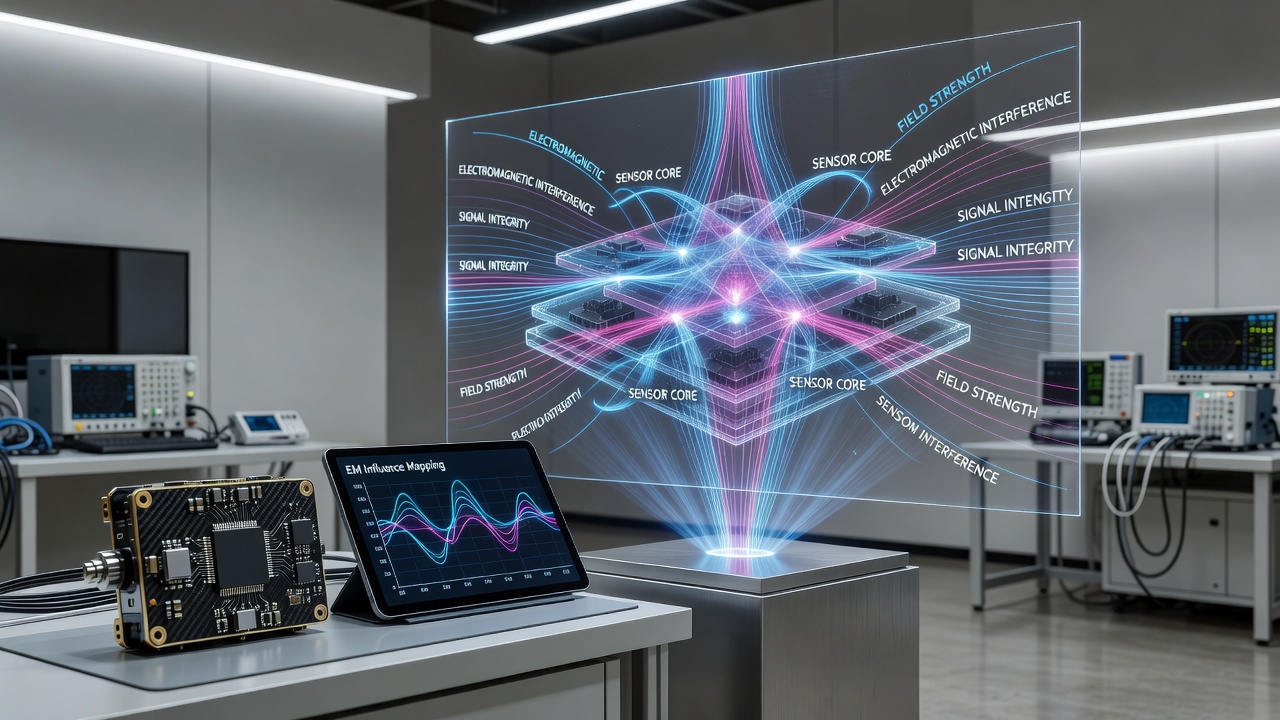
Modern sensor systems operate amid overlapping electromagnetic fields that originate from power lines, wireless networks, and nearby electronic components, creating conditions where interference patterns emerge at multiple frequencies simultaneously. Engineers address these intersecting influences through targeted design strategies that maintain signal integrity while meeting performance specifications across applications such as automotive radar, medical imaging equipment, and industrial automation platforms.
Core Electromagnetic Interactions in Sensor Environments
Electromagnetic interference occurs when external fields couple into sensor circuits through conductive paths or radiated emissions, and researchers document how multiple sources combine to produce nonlinear effects that single-source models often overlook. Data from laboratory tests indicate that low-frequency magnetic fields from motors can modulate higher-frequency radio signals, leading to demodulation artifacts in analog front-end stages. Those who study these phenomena note that capacitive coupling dominates at shorter distances while inductive effects prevail in larger installations, creating design trade-offs that vary with operating frequency and physical layout.
Shielding materials such as mu-metal and conductive composites provide attenuation levels measured in decibels, yet their effectiveness depends on seam integrity and grounding topology. Studies conducted at research facilities reveal that even minor gaps allow field leakage that degrades sensor resolution, particularly when broadband sources like variable-frequency drives operate nearby. Design teams therefore incorporate layered shielding combined with filtering networks that target specific bands, and this approach has shown measurable reductions in noise floors during controlled validation sequences.
Design Methodologies for Managing Multiple Field Sources
Simulation software now models intersecting fields by solving Maxwell's equations across three-dimensional geometries, allowing engineers to predict coupling coefficients before hardware fabrication begins. According to information published by the National Institute of Standards and Technology, standardized test procedures quantify susceptibility across frequency ranges from 10 kHz to 40 GHz, providing benchmarks that manufacturers reference during compliance verification. NIST electromagnetic compatibility resources detail measurement techniques that isolate contributions from individual sources even when fields overlap in time and space.
Printed circuit board layouts incorporate guard traces, differential signaling, and strategic component placement to minimize loop areas that act as unintended antennas. Observers report that twisting wire pairs and adding common-mode chokes reduces conducted emissions by amounts documented in application notes from component suppliers. When digital and analog sections share the same substrate, separation distances combined with local decoupling capacitors limit crosstalk that would otherwise appear as periodic noise correlated with clock edges.

Application Areas and Performance Data
Automotive sensor suites integrate ultrasonic, radar, and camera systems whose electromagnetic environments include ignition systems, electric motors, and cellular transceivers operating concurrently. Measurements collected during vehicle-level testing demonstrate that proper frequency planning prevents false triggers in collision-avoidance algorithms. In medical devices such as implantable monitors, sensors must reject fields from MRI scanners and electrosurgical units while preserving microvolt-level physiological signals, and compliance records show that filtered feedthroughs achieve the required attenuation.
Industrial environments present additional challenges from variable-speed drives and wireless sensor networks that share spectrum with control instrumentation. Figures released by the European Telecommunications Standards Institute outline emission limits that equipment must satisfy to coexist within factory settings, and facilities adopting these guidelines report fewer unplanned shutdowns attributed to signal corruption. Canadian research initiatives have examined similar intersections in mining equipment, where high-power radio communications overlap with precision position sensors, confirming that adaptive filtering maintains accuracy under dynamic load conditions.
Emerging Trends Through 2026
Advancements in materials science introduce metamaterials engineered to exhibit negative permittivity at targeted bands, offering compact alternatives to traditional enclosures. Prototypes tested in September 2026 demonstrations at international engineering conferences illustrated attenuation improvements exceeding 20 dB compared with conventional approaches at millimeter-wave frequencies. Integration of machine-learning algorithms for real-time interference classification allows sensors to adjust gain and filtering parameters dynamically, and preliminary field trials indicate reduced error rates in environments where static designs previously failed.
Regulatory bodies continue updating emission and immunity requirements to reflect denser spectrum usage driven by 5G deployments and industrial IoT expansion. These updates emphasize system-level testing that accounts for simultaneous exposure to multiple field types rather than isolated single-frequency assessments, and manufacturers who align development cycles with the revised schedules achieve certification on first submission more consistently.
Conclusion
Intersecting electromagnetic influences shape sensor performance across every major engineering domain, and systematic approaches to modeling, shielding, and filtering deliver reliable operation even under complex field conditions. Continued refinement of simulation tools, material properties, and adaptive algorithms supports ongoing deployment of sensors in increasingly crowded electromagnetic landscapes, with measurement standards from multiple regions providing consistent frameworks for validation and comparison.